SEMO Historian
Where history meets the present
Jennifer Wiesner
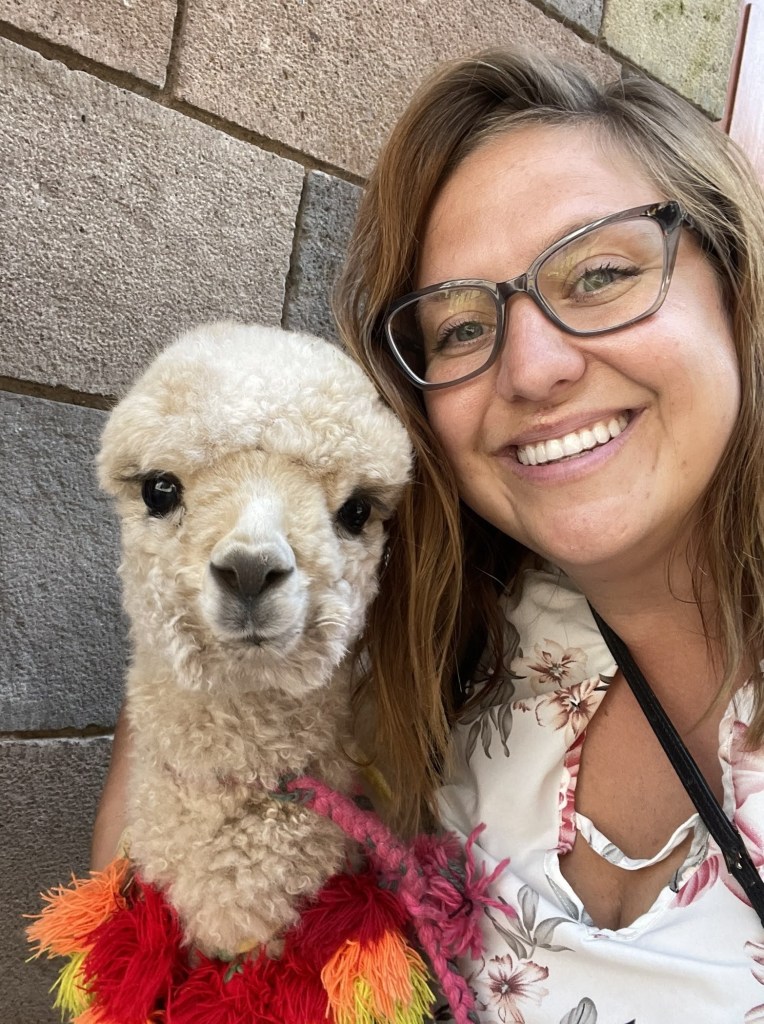
Hey there! My name is Jennifer Wiesner.
I was born in Chicago and spent my younger years in the city before moving to central Kentucky as a teen. Growing up, I was always very sociable, curious, and hungry for knowledge. I maintained a diverse group of friends, took my time in museums, and always asked “too many questions”. My parents liked to point out that I was “unique” and bossy, while my teachers helped me cultivate my studious personality and leadership skills.
After earning my GED, my mentors advised me to apply for some scholarships and enroll in college.
I earned my BS in Anthropology from Southern Illinois University Edwardsville, where I majored in Archaeology and minored in Native American Studies. Once I found anthropology, I knew I found my place in the world. Nothing makes me happier than talking about archaeology/anthropology and having a career where I can advocate for the preservation of the past.
I completed two internships at the Cahokia Mounds Interpretive Center and have volunteered my time doing archaeological excavations at the Cahokia Mounds State Historic Site.
I was interested in Southeast Missouri State University because the Historic Preservation program is unmatched when it comes to real experience, affordability, and faculty advising. I was specifically interested in studying architectural history and after some research, I found that SEMO graduates get exactly the careers and experiences that I was looking for.
I chose the MA in Public History because it will give me exactly the experience and confidence I need to complement my skills within cultural resource management. Architectural history and archaeology have a lot in common when it comes to reporting significant sites to state agencies and adhering to state and federal laws. The HP program at SEMO covers all the bases and allows you to gain the skills to do architectural history as well as the skills to clearly communicate the historical significance to multiple audiences such as friends, family, tourists, locals, patrons, students, and state and federal agencies.
I really like the Public History graduate program so far because the small class sizes and internal department events give me the opportunity to build meaningful relationships with my classmates and mentors.
I was in awe of the beauty of the Main Campus at Cape and how friendly everyone has been. From my inquiries before I started the program up to my participation in the program now, all of my experiences getting started were met with equal enthusiasm, a wealth of knowledge, and credibility.
In the next few months, I’m looking forward to getting more familiar with all of the opportunities and resources to study historic preservation available to me.
Molly McNabb
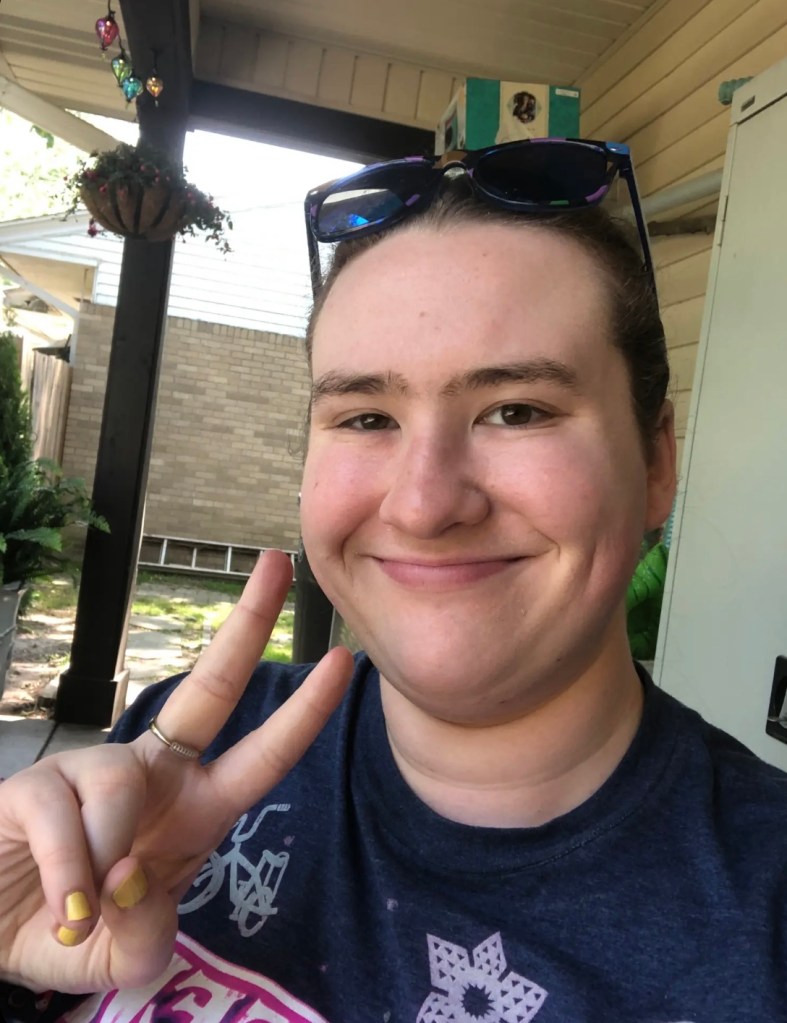
Hi, my name is Molly McNabb. I am from Cape Girardeau, Missouri and attended nearby Saxony Lutheran High School, graduating from there in 2019 and attending Southeast Missouri State University for my undergraduate degree (which was in History).
My career goal is to become a history professor, and I am currently in my first year in the Public History program at Southeast Missouri State.
I am still very involved in the local community, running a junior high school newspaper and a Scholar Bowl team. Cape Girardeau is a small town, but definitely has aspects that make it feel like a much bigger city.
My family has been coming to SEMO for years, so I decided to continue their legacy. The classes here are great–they are so small and that has given me the opportunity to get to know my classmates very well. I also have good relationships with all of my professors.
I look forward to getting acclimated to the graduate program and working on group projects with some of my new friends.
Veronica Beck
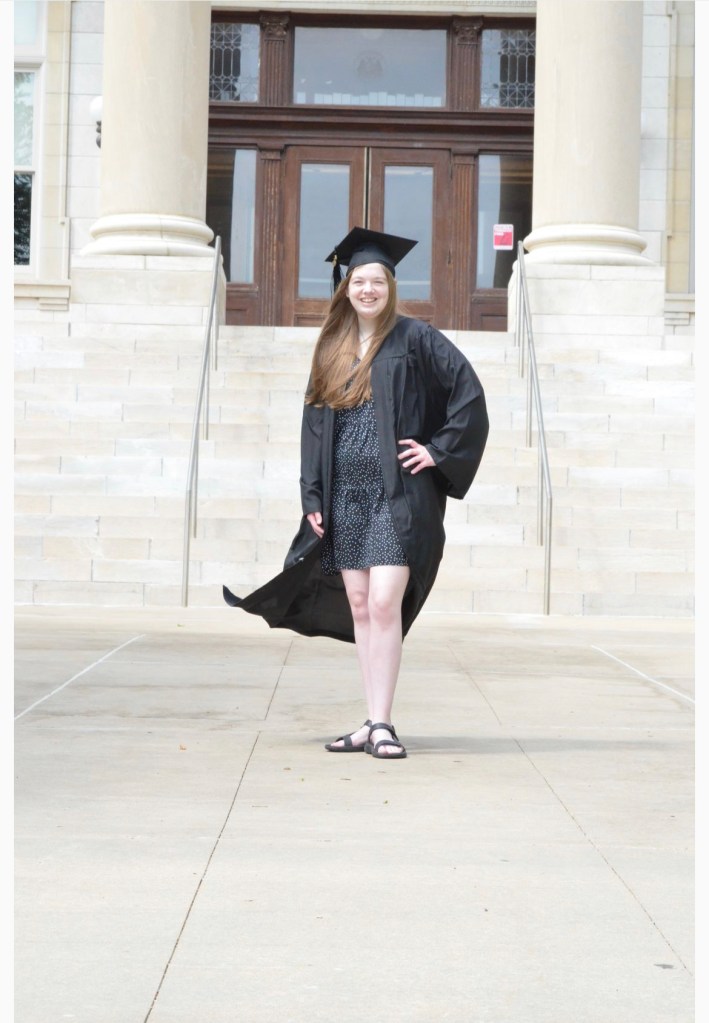
Hi, my name is Veronica Beck.
I am from South city Saint Louis and attended Rosati Kain High School, where I graduated in 2019.
I earned two undergraduate degrees (History and Historic Preservation) at Southeast Missouri State University.
I have been a intern at the Missouri State Archives in Saint Louis as well as the Campbell House.
I was interested in Southeast Missouri State University because of how close it was to home, affordability and the acclaimed Historic Preservation program, and chose to get a master’s in Public History because I have always loved history and I wanted to have a job in it that was not teaching in elementary or high schools.
I really like the Public History graduate program so far because it gives me a great education as well as the ability to finish in a year with the 4+1 program.
The Cape Girardeau/SEMO environment is very different from Saint Louis but I have grown to truly love it and the people.
Andrea Mullins
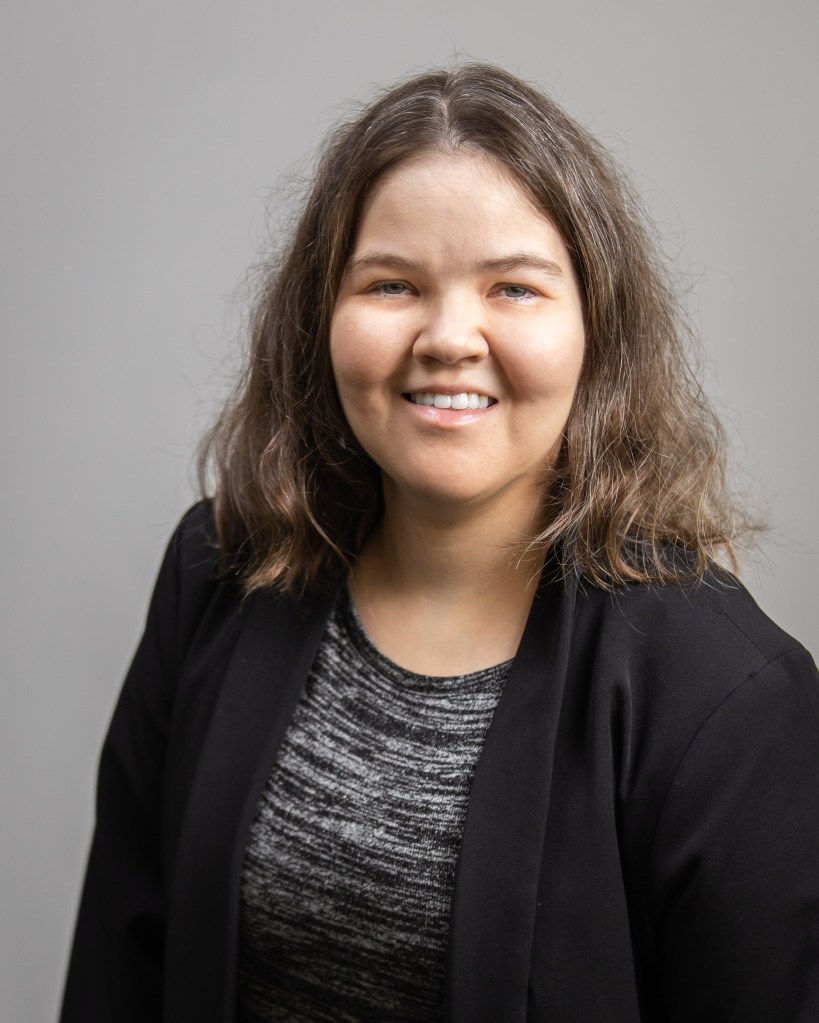
Hello, my name is Andrea Mullins. I am originally from Charleston, WV, but I grew up in the Cape Girardeau /Jackson area and have lived here most of my life. I was homeschooled and earned my high school diploma through an online program called Penn Foster High School, based in Scranton, PA. From there, I attended Southeast Missouri State University, where I completed my bachelor’s, double majoring in Social Science and French, with a minor in Religious Studies.
When I first started my academic career, I was undecided what path I wanted to take, so the interdisciplinary nature of the social science degree program appealed to me. That and it was online, which I needed that flexibility at the time. History was one of the focuses of the program and I really loved history, so I decided to make that my primary concentration, with anthropology as my secondary concentration. I majored in French because I knew that I would need reading abilities in at least a second language and because it was an amazing program.
I joined the MA program at Southeast because I completed my bachelors at Southeast and wanted to continue researching and writing about Stella Walsh with Dr. Criblez. It is also close to my home so I didn’t need to relocate. I have found Southeast to be flexible (with online and hiflex classes) and affordable, both qualities that are positives for me.
I love historic preservation because historic preservationists make sure that the physical evidence of our past doesn’t disappear. And because they make history available to the public whether it’s in museums, archives, or historic sites. I believe historical literacy is of the utmost importance.
The first year of the MA in Public History program was a challenge, since I was new to historic preservation. There were also a lot of things that I really enjoyed. I loved Dr. Rhodes’ Cold War seminar, where I had the opportunity to write a paper about how Cold War politics influenced the US government’s stance on health and physical fitness. I also enjoyed Dr. Criblez’s Intro to Public History class and the opportunity to experience different aspects of public history. Additionally, I had my first experience with developing museum exhibits that semester when I worked with the HPA on their 40th anniversary banquet and exhibit.
When I was younger, I variously wanted to be a private investigator, a lawyer, or have some other type of legal/investigative type career, because I’ve always been very good at solving puzzles and taking little bits of information and making sense of them. Before coming to Southeast, I did try law for a bit, made a C in tort law, then moved on to my current career path.
I like the small town atmosphere not only in Cape Girardeau, but also how that carries over into the small campus of Southeast and the smaller class sizes. I love the ability to really get to know people and make friends, and to really have that personal connection with faculty, staff, and classmates that isn’t possible on larger campuses or in areas with higher populations.
Things I’m looking forward to: opening my exhibit on Stella Walsh at Heritage Hall; presenting my paper “Stella Walsh: Queen of the Stadium” at the Missouri Conference on History; and the HPA banquet in April.
Jerry Henson

Hi, my name is Jerry Henson. I am originally from New Madrid County and grew up around Morehouse and Sikeston. After graduating from Sikeston Senior High School in 1990, I headed off to Marine Corps bootcamp in San Diego. I spent five years in the Corps, most of that on the West Coast, but with deployments to Japan, Canada, and Korea.
After my enlistment ended, I spent two years at San Diego State University, which has a great Classics department, then transferred to Tulane University in New Orleans to finish up undergraduate degrees in Classics and Ancient History. While at Tulane, I worked as a student archivist at the Amistad Research Center and the Southern Institute for Education and Research. I also tutored elementary school students as part of the Start the Adventure in Reading (STAIR) program.
At that time, Tulane was ending its teacher education program, but I was able to minor in education and the coursework included practicums in New Orleans public schools. Jonathan Kozol’s Savage Inequalities was a huge inspiration for me at the time and I had intended to be a career public school teacher, but I never got a call from the New Orleans public schools’ central office after graduation! My first job out of Tulane was at the Isidore Newman School and I spent the next twenty-some years at the best private schools in New Orleans. I taught at the high school level, mostly courses in World History, Modern European History, and United States States History, and was a faculty advisor to several student clubs. The last years I spent in New Orleans were in administration, including stints recruiting and training faculty, writing curriculum, admission, communications, and fundraising.
In 2022, after spending half of my life in New Orleans, and following through on a promise to myself to start packing after Hurricane Ida, it was time to return home. I had researched other graduate programs in the region, but SEMO checked all of the boxes. While my studies in the past have been very specialized and necessarily esoteric, I am excited that SEMO will allow me the opportunity to explore local history while also providing the full scope of coursework for public history and historic preservation. Having studied and taught the Classics for many years, which in retrospect can sometimes seem elitist and anachronistic, the prospect of studying Public History, which is so dynamic and of-our-times, was the antidote to many of my professional frustrations.
This first year has been an awakening of sorts. It took a few weeks to remember what it means to be a student again, after having been on the other side of the desk for decades, but SEMO provided the best-possible situation in terms of coursework, classmates, professors, and advising. Before attending my first class, I had already been provided with a roadmap for graduation and employment, which was unreal given my experience at Tulane, which was great, but too large to really take a personal interest in individual student success. In summary, I would say that SEMO, Cape Girardeau, and the Public History program have all been a perfect fit for me.
Currently, I am having frequent conversations with myself about whether to take all that I have learned back to the classroom or to seek a career in the educational department of a museum. A few months ago I was convinced that classroom teaching would stay in my rearview mirror, but lately my thinking is that maybe I just needed a recharge and a revised toolkit, not a complete change. In the next few months I look forward to some travel, Italy and England are on the agenda for the summer, and doing some more work on my house, a 1950’s Wright-inspired contemporary structure that looks completely out of place in Sikeston!
Griffin King
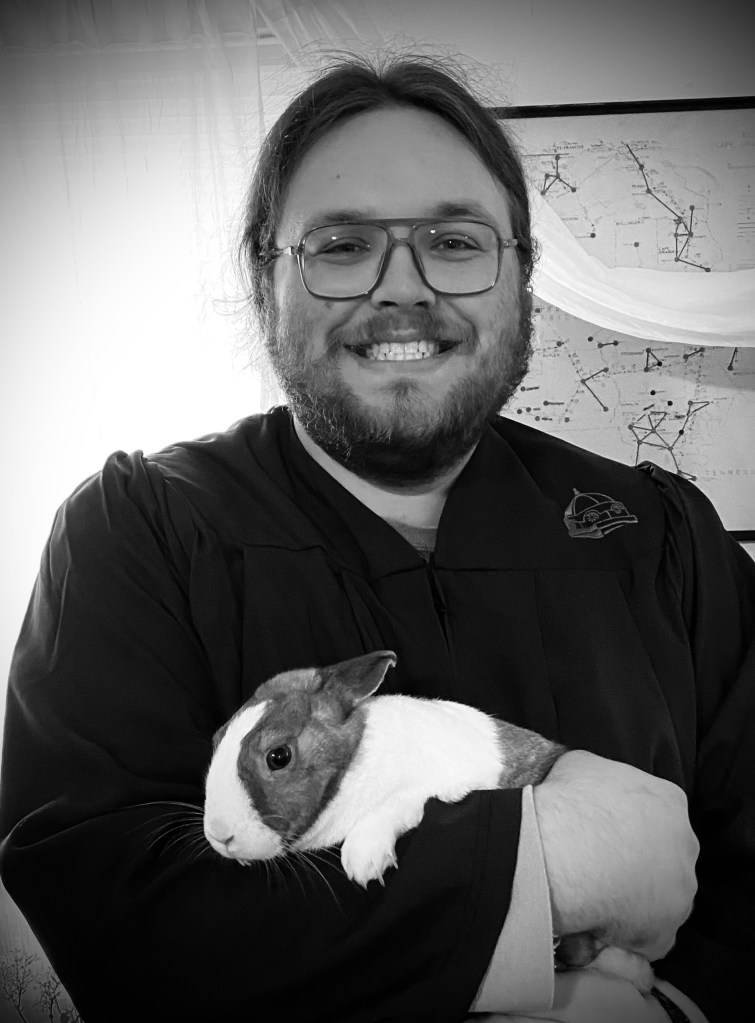
Hi, my name is Griffin King and I’m a first-year MA student here at Southeast Missouri State, focused on Historic Preservation. I was raised in Cape Girardeau and attended Cape Central High School. After graduating, I enrolled at SEMO where I was originally was a Social Studies Education major. But after my first round of student teaching I realized that I was more concerned with content than pedagogy, thus I changed my major to a BA in History.
I’ve lived in Cape Girardeau my entire life, and SEMO has always been a part of it (childhood birthday parties at the Student Rec Center, Model UN at the University Center, etc.). As a result, it is incredibly satisfying to continue to see those same parts of the cultural landscape as a young adult in a different way. It’s very meaningful and special to me that the town I was born in possesses a program through which I’ve been able to get both a bachelor’s degree and start a master’s program
I served as a student intern at the Baptist Student Center from June 2019 to May 2022; my most involved project was my senior thesis (“An exploration of the motives for and the very notion of ‘radicalism’ as it pertains to the American labor movement of the Progressive Era,” under Dr. Eric Clements and Dr. Pete Soland).
I love the Cape Girardeau (and southeast Missouri) community, especially the SEMO community; my parents and grandparents also attended SEMO and I’m very proud of the way that SEMO makes higher education accessible (especially to the rural parts of southeast Missouri)
My experiences in grad school thus far have been great; the best part of it is belonging to a community of friends and advisors who approach learning with academic rigor yet maintain a fun and sociable atmosphere. I feel very much welcomed by everyone.
I look forward to having a publishable work by the end of the Spring 2023 semester and learning about historic building materials with Dr. Hoffman!
Amanda Lawson
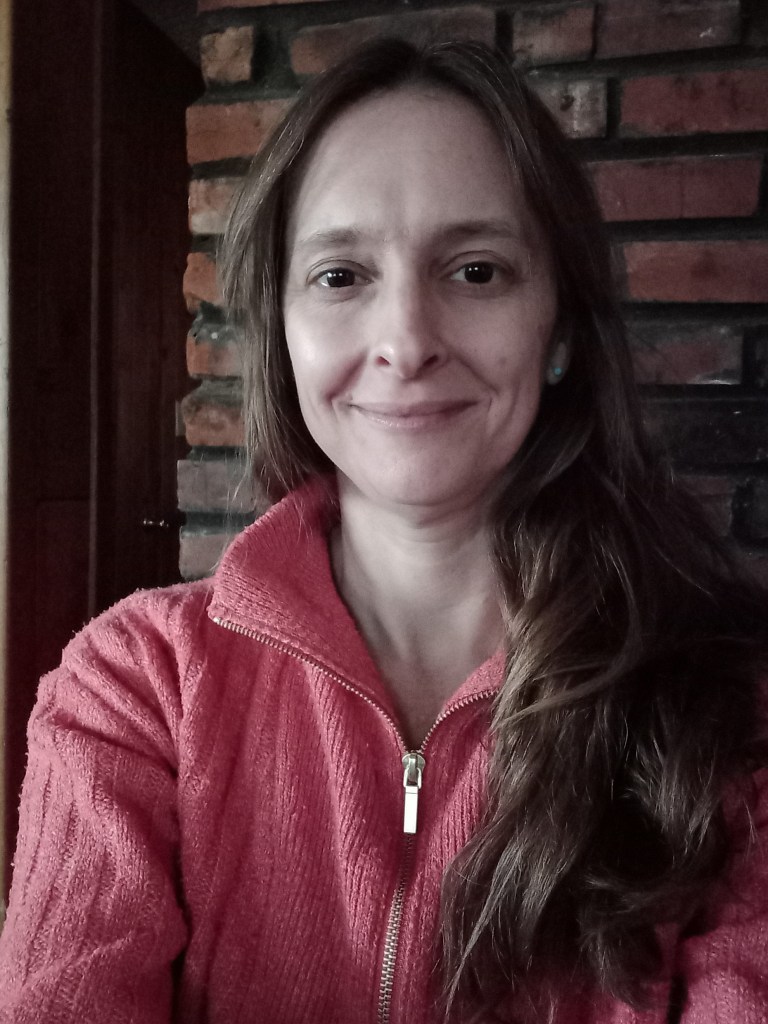
Hi, my name is Amanda Lawson, and I am a first-year student in the graduate program focusing on Historic Preservation.
I was born in Mountain View, MO at the ripe old age of 0 and then went to 4 different high schools in 4 years before I graduated from Chamois, MO, 1995.
My undergraduate degree was attained in 2006 from Missouri State University in Springfield, MO, in 2006 with a B.S. in Anthropology. (Biology minor). While at Missouri State I participated in archaeological field school and ethnographic Field School before working in the Cultural Resource Management field for several years afterwards.
I have been all over the US with my CRM profession, then to Europe for 5 years to immerse myself in some other cultures. Naturally, after being away for so long and with the Covid drama I was looking for the comforts of home and to restarting my career but in a different fashion. Loved fieldwork but looking for a new direction. Found the HP program at Southeast which was intriguing due to its location being closer to home but also the topics of historic preservation which comfortably fit with Anthropology and prospects of public education.
I greatly enjoyed my first semester back into academia/professional world. HP and Anthropology are very comfortable subjects. I enjoy the topics and since I have been engaged a bit in the professional world with anthro and history, I feel like I can hold my own when discussing historic preservation issues or anthropological studies and methods. Mostly, it is a joy to be around my peers again who have the same interests that I do, who can speak my language, (in more ways than one) where deeper conversations can be had about these subjects and where I can continue to learn about the areas of which I am fuzzy. (Which are, happily, many) Also I was super impressed by the staff. I found everyone to be extremely helpful, caring and knowledgeable.
So, what do I want to be when I grow up? First, I have found that growing up is overrated. And second, I am searching high and low for a definite answer to this because I am fascinated with many things having to do with this department. Working for a National Park in the western half of the US is one thing but the more I am in Cape, the more I am looking at this immediate area for future profession options.
The first time I visited Cape Girardeau I had just been accepted to the program and was visiting the university and took a quick jaunt around town. The next time I visited Cape I was moving here. I had, of course, done some research before hand about the towns history and demos and what there was to do and where the nature things and museums were because I would do that anywhere I went. I like the size of the town, that it is a Mississippi River town with a good amount of history and that Mark Twain noticed it. Once I was really here I loved that it was very family friendly, had a downtown with some character and that the people that I interacted with were extremely friendly and helpful.
I am looking forward to continuing the fine tuning of my HP knowledge and getting to know our Anthropological side too. Research is probably my weak point so I am excited to delve deeper into this with Dr. Lily Santoro. And with Dr. Steven Hoffman I am excited to learn more about the National Register qualifications and to put that into action. Also, I would like to visit the anthropologists to see what projects they are working on.
Hannah Houston
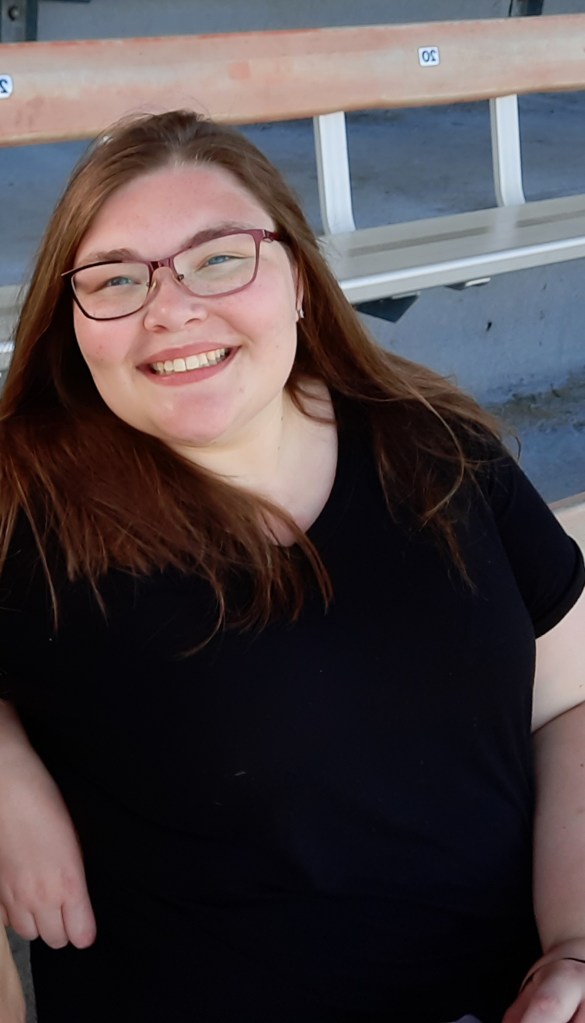
Hi, my name is Hannah Houston and I am in my first year as a graduate student at Southeast. I grew up in Charleston, Illinois and came to Southeast to earn my degree in Historic Preservation in 2022. I found Southeast while looking into what archives are and what schooling is needed to become an archivist. Before SEMO I was a history major at a different institution and wanted something more hands on.
I am currently the Graduate Assistant at Special Collections and Archives in Kent Library. Over the Summer I interned at the Cape Girardeau County Archives, and I am currently working on a National Register Nomination for Lincoln Junior High School in Sikeston, Missouri. I am still figuring out what I want to do after graduation, I really focused on archives during my undergraduate degree and still do archival work. In the last year I have started gaining interest in built environment.
I like Cape Girardeau because it is a lot like my hometown. We have a college about the same size, but it is a very family friendly environment but with more retail options. I do enjoy that Cape has a historic downtown and organizations that work to preserve the area’s history.
I have enjoyed my first year as a graduate student. I have been able to continue to build relationships with faculty on campus and continue to learn skills that will help me in a professional environment.
Lily Clajus and “Georgia, Georgia”
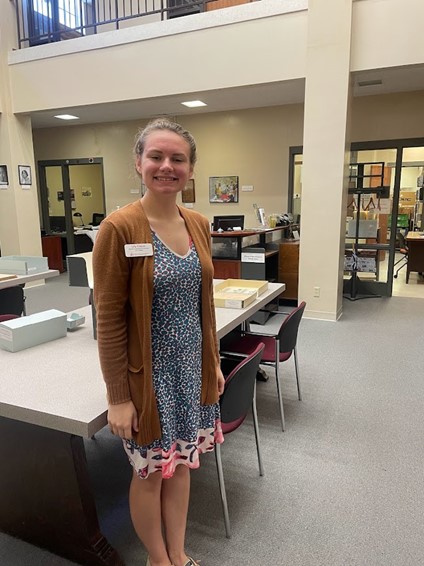
I came to Southeast Missouri State University five years ago for the undergraduate historic preservation program, the only one of its kind in Missouri and one of nine nationwide. While I was exposed to the many pillars of HP, my interests were predominantly archives and records management. Throughout undergrad I worked in Kent Library’s Special Collections and Archives (SC&A), where I gained experience doing local research, arranging archival collections, and writing finding aids. I heard about the new Accelerated Graduate Program my junior year, and soon enough became the department’s fifth student to enroll in the program.
For grad school, I stayed with the SC&A as their graduate assistant, which came with many responsibilities and challenges. I experienced an overall higher level of accountability, meeting with my supervisors regularly to track progress and assign tasks. Moreover, the unit was short-staffed – we only had one full-time archivist and a handful of student workers, so maintaining the day-to-day operations was difficult at times. As I wrap up my time here at SC&A, one project stands out as a marker of my success in this role and has left me with skills I will take into my professional life.
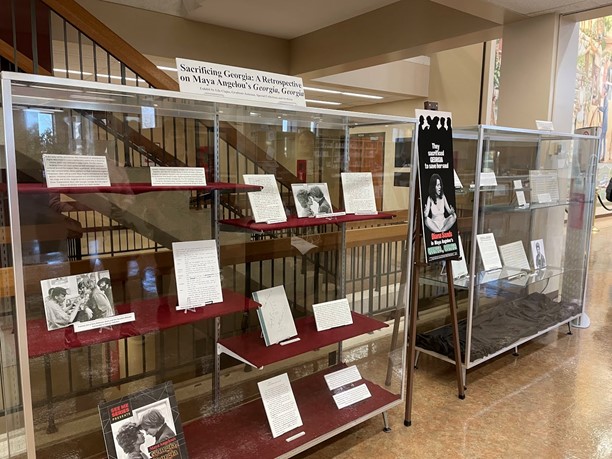
In one of my first meetings with Kent Library dean Barbara Glackin after becoming the graduate assistant, she asked me to take part in an interdepartmental project centered around the 1972 film, Georgia, Georgia, written by Maya Angelou. This project debuted under the Department of Mass Media’s newest initiative to explore diverse creative works, known as the See Me Series. In celebration of its 50th anniversary, over 20 classes integrated the film into an assignment, followed by a public screening and discussion with one of the film’s stars, Dirk Benedict. My task was to create a two-case exhibit about the film for the main floor of Kent Library.

Having taken Dr. Rhodes’ seminar about Cold War America the semester before, I was familiar with both the Vietnam era and the Civil Rights Movement, which helped me understand the significance of this little-known creative work. As the first feature film based on an original screenplay written by a black woman, the film intersected topics of class, race, privilege, prejudice, and sexuality against the backdrop of the Vietnam War, completed by a multicultural cast and crew.
My first task was reaching out to Wake Forest University’s Special Collections and Archives, which manages the Maya Angelou Film and Theater Collection, for materials about Georgia, Georgia. While I have completed many remote research requests within SEMO’s archives, it was eye-opening to interact with an archives as a researcher. From them, I obtained scans of publicity stills, press kits, screen treatments, promotional papers, and even sheet music! I collaborated with Dr. Karie Hollerbach from the Department of Mass Media, the project’s coordinator, to look over the scans and select those items to be displayed in the exhibit. Based on the available materials, we decided that the exhibit would focus on four aspects of the film: plot, production, music, and reception. I then reached out to Wake Forest for permission to display the selected materials and sent our selections to University Marketing to be touched up.
After writing the contextual paragraphs for the exhibit, it was time to actually construct the exhibit. I utilized Kent Library’s large format printer to produce high-quality reproductions of the selected materials, written text, and captions. This ended up being the hardest part, as there was a steep learning curve to operating the printer. All documents were then mounted onto foamboard and cut to size. Dr. Hollerbach dropped off an oversized promotional flyer for the campus screening and the movie’s poster, which turned out to be wonderful additions to the exhibit. With everything scanned, printed, cut, and mounted, it came time to put it all together – although the cases themselves were a bit larger than I anticipated, I am incredibly proud with how it turned out.
Jason Elders
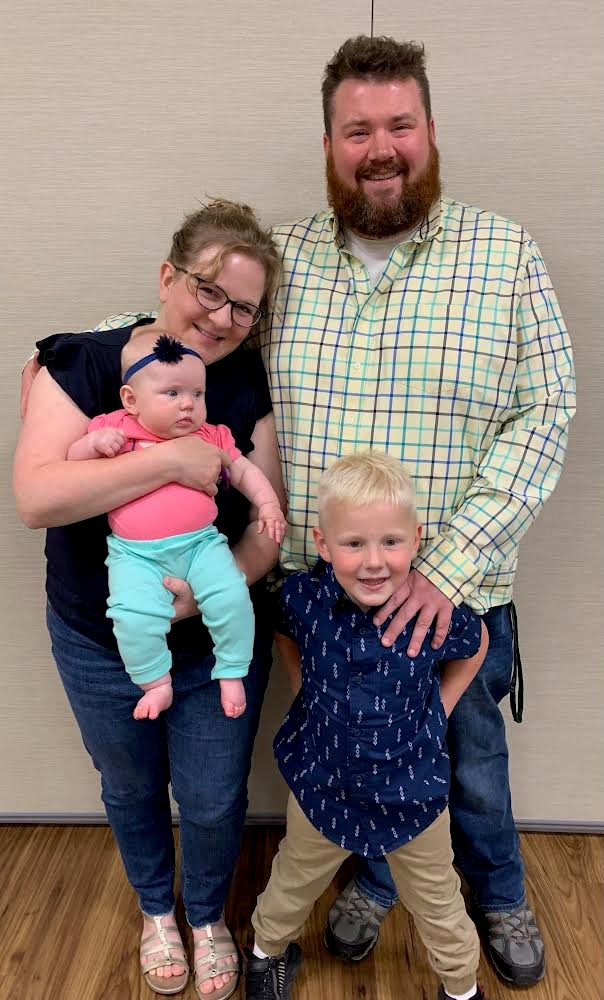
Hi, my name is Jason Elders. I am a Social Studies educator and will soon graduate with a Master’s Degree in History at Southeast Missouri State.
I was born in St. Louis. I lived on Minnesota Street until my family moved out of the city when I was in the sixth grade. My family moved to DeSoto, Missouri, and I attended Junior High there. I graduated from DeSoto High School in 2002.
I became interested in Southeast when I realized that I could combine my schedule to two days a week and commute from Ste. Genevieve, MO. If I am being 100% honest I also chose Southeast because my partner had graduated from Southeast and recommended it to me. I admit that is probably not the best justification for choosing an institution of higher learning, but I graduated and we eventually got married so everything worked out in the end.
I received my undergraduate degree from Southeast in Secondary Social Studies Education. I chose Social Studies Education because I believe that all people are fundamentally the same regardless of the time period they lived in or their location. My goal is to emphasize this shared human experience with my students and show them that history is only boring when it is being taught incorrectly.
I love participating in the History Graduate program! I love interacting with intelligent, enthusiastic people that are interested in the same things that I am. There is only so much of my content that my family and friends want to listen to me talk about. It is incredibly fulfilling to have knowledgeable, passionate fellow students and faculty to share ideas with.
I spent the first 20 or so years of my life as a diehard Drama Kid. As I matured I chose a career that was a little more stable. I enjoy teaching social studies because it allows me to share meaningful true stories while still utilizing some of my public speaking skills.
I like SEMO’s relatively small class sizes. All of my classmates are always friendly and helpful. SEMO feels like a safe little welcoming community.
Once I have completed my Master’s Degree I will be qualified to teach college credit courses at the high school where I am employed. I am extremely excited to increase my American History content knowledge and be able to better serve my students.
I have had some amazing opportunities while at Southeast. The summer of 2021 I participated in the National Park Services’ Teacher Ranger Teacher Program (that is the program’s actual name, despite the fact that it looks like a typo.) During this unique internship I wrote curriculum for 3rd graders specific to Sainte Genevieve National Historical Park, I had the opportunity to interact with guests in the visitors center, do a small amount of independent research, and to lead tours of the Jean-Baptiste Vallé and Bauvais-Amoureux historic homes. I would highly recommend working with the National Park Service if you are given the opportunity.
 SEMO Historian